Blog / Life Insurance & Protection
Term vs Whole Life Insurance: Which One Fits Your Family?
Term vs whole life insurance in plain English: how each works, what they cost, living benefits, and a simple way to decide which one fits your family.
Here’s the short answer on term vs whole life insurance. Term life insurance covers you for a set number of years (often 10, 20 or 30) and usually costs much less. Whole life insurance covers you for your whole life, has fixed premiums, and builds cash value you can use later, but it costs a lot more for the same death benefit.
Most young families start by asking, “How do I protect my people at the lowest cost?” and for a lot of them, term is the starting point. Whole life makes sense in specific situations, which I’ll walk through below.
I’m Sal. I’m a licensed life insurance Financial Professional with Global Financial Impact (license LA-1933647), and I’m also a dad who had to figure all this out for my own family. So let’s keep it simple.
What life insurance actually does
Life insurance is a contract. You pay the insurance company a premium, and if you pass away while the policy is active, the company pays a death benefit to the people you named (your beneficiaries). That money can replace your income, pay off a mortgage, cover childcare, or simply give your family time to grieve without money stress.
This part is personal for me. When my brother passed away unexpectedly at a young age, I watched my mom struggle to cover his funeral and gravestone costs. She had to start a GoFundMe at the worst time of her life. I never want another family to go through that, and it’s a big part of why I do this work.
Both term and whole life do that core job. The difference is how long the coverage lasts, how the price works, and whether the policy builds any savings inside it.
How term life insurance works
Term life is the “rent” version of life insurance. You pick a coverage amount and a length of time, called the term.
- Common terms: 10, 15, 20, 25 or 30 years.
- Premiums: usually level, meaning they stay the same for the whole term.
- Cash value: none. If the term ends and you’re still here (which is the goal), the policy simply ends.
- Cost: usually the lowest-cost way to get a large death benefit, especially when you’re young and healthy.
Why people like term
It matches the years when your family depends on your income the most. If your youngest is 3 and your mortgage has 28 years left, a 30-year term lines up nicely with the years your family would feel the biggest hit.
What to watch for
When a term policy ends, buying new coverage later will usually cost more, because you’re older and your health may have changed. Many term policies include a conversion option that lets you switch part or all of the policy to permanent coverage without a new medical exam, within a set window. That feature is worth asking about.
How whole life insurance works
Whole life is a type of permanent life insurance. As long as you pay the premiums, it covers you for life.
- Premiums: fixed. They don’t go up as you age.
- Death benefit: guaranteed, as long as the policy stays in force.
- Cash value: part of each premium builds a cash value that grows on a guaranteed schedule set in the contract. Growth inside the policy is tax-deferred.
- Dividends: some whole life policies from mutual insurers may pay dividends. Dividends are not guaranteed.
- Cost: much higher than term for the same death benefit, because you’re paying for lifelong coverage plus the cash value.
Using the cash value
You can usually borrow against the cash value or, in some cases, withdraw from it. A policy loan accrues interest, and any loan you haven’t paid back is subtracted from the death benefit. If loans grow too large, the policy can lapse, which can also create a tax bill. So the cash value is useful, but it isn’t free money.
Whole life insurance vs term: side by side
If you’ve been searching “whole life insurance vs term,” this table is the quick version.
| Feature | Term life | Whole life |
|---|---|---|
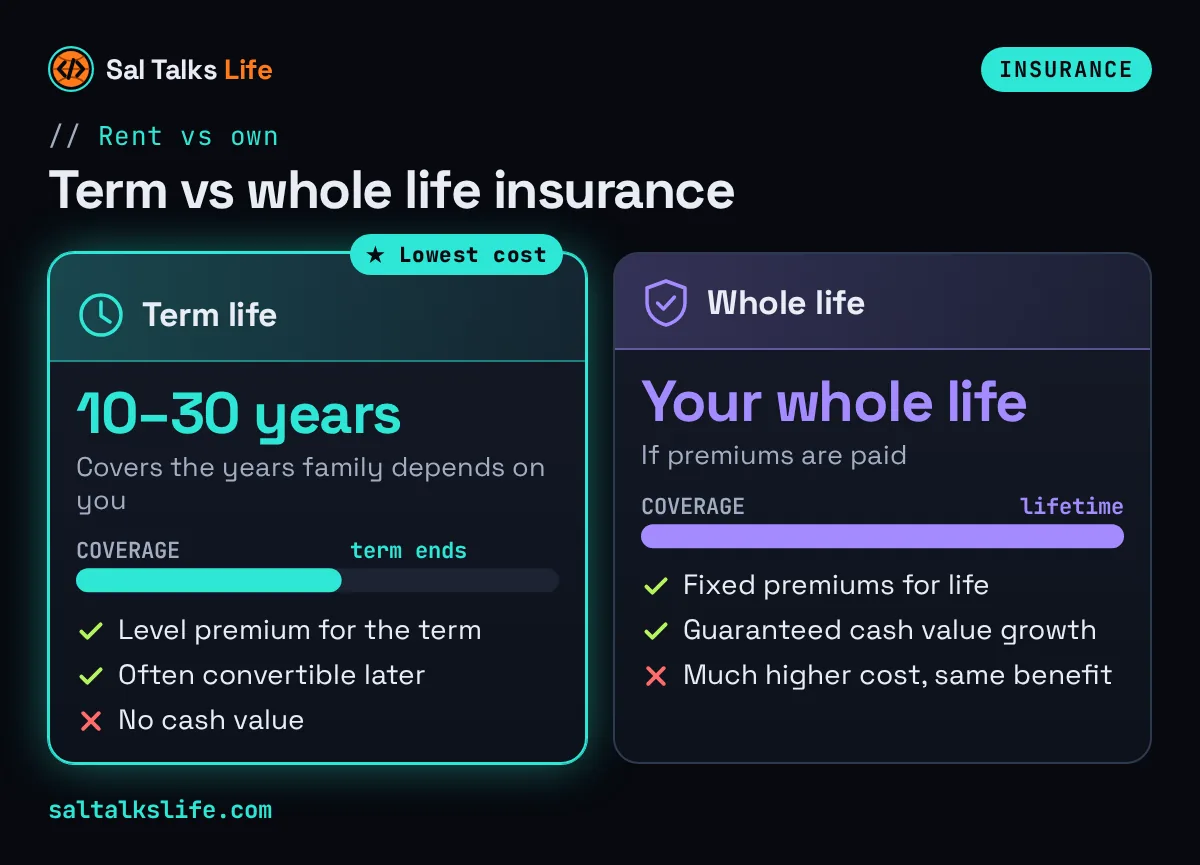
| How long it lasts | A set term (e.g. 10 to 30 years) | Your whole life, if premiums are paid |
| Premium | Usually level for the term | Fixed for life |
| Relative cost | Lowest for a large death benefit | Much higher for the same death benefit |
| Cash value | None | Yes, grows on a guaranteed schedule |
| Can you borrow from it? | No | Yes, through policy loans |
| Best at | Covering the years your family depends on your income | Lifelong needs and steady, guaranteed growth |
| Flexibility later | Often convertible to permanent coverage | Policy loans, possible dividends |
Living benefits life insurance: protection while you’re alive
Here’s the part most people have never heard of. Many policies, both term and permanent, can include living benefits. These are usually riders (add-ons) called accelerated death benefit riders. They let you use part of your death benefit early if you have a qualifying illness.
Typical triggers include:
- Terminal illness: a diagnosis with a limited life expectancy, as defined in the policy.
- Chronic illness: being unable to do a set number of basic daily activities, like bathing or dressing, on your own.
- Critical illness: certain serious conditions named in the policy, such as a heart attack, stroke or some cancers.
How living benefits work
If you qualify, the insurer pays you a portion of the death benefit while you’re alive. You can use that money however you need: medical bills, keeping the lights on while you can’t work, or a spouse taking time off to care for you. Whatever you use is taken out of the amount your beneficiaries would receive later.
What to check before you count on them
- Riders, triggers and payout amounts vary by company, by product and by state.
- Some riders are built in at no upfront cost, others add to your premium.
- The payout may be reduced or discounted, depending on how the rider is designed.
When I sit down with families, this is often the feature that changes how they think about life insurance. It isn’t only about “when I’m gone.” It can also be about “if something happens and I can’t work.”
How to choose: a simple 4-step check
You don’t need a spreadsheet to start. Answer these four questions.
1. Who depends on your income, and for how long?
Write down the years until your kids are grown, your mortgage is paid, or your partner could manage on their own. That number of years points you to a term length.
2. How much coverage would your family need?
A common starting point is to add up debts (mortgage, car, credit cards), future costs (childcare, college if that’s a goal), and several years of your income. Then subtract savings and any coverage you already have through work. Work coverage often ends when you leave the job, so don’t lean on it alone.
3. What can you comfortably pay every month?
The best policy is the one you can keep paying. A policy you cancel after two years protects nobody.
4. Do you have a lifelong need?
Some people want coverage that lasts no matter what: final expenses, leaving money to someone, caring for a child with special needs for life, or estate planning. That’s where permanent coverage like whole life is worth a look.
A simple example
Let’s look at a made-up family. These are not real quotes.
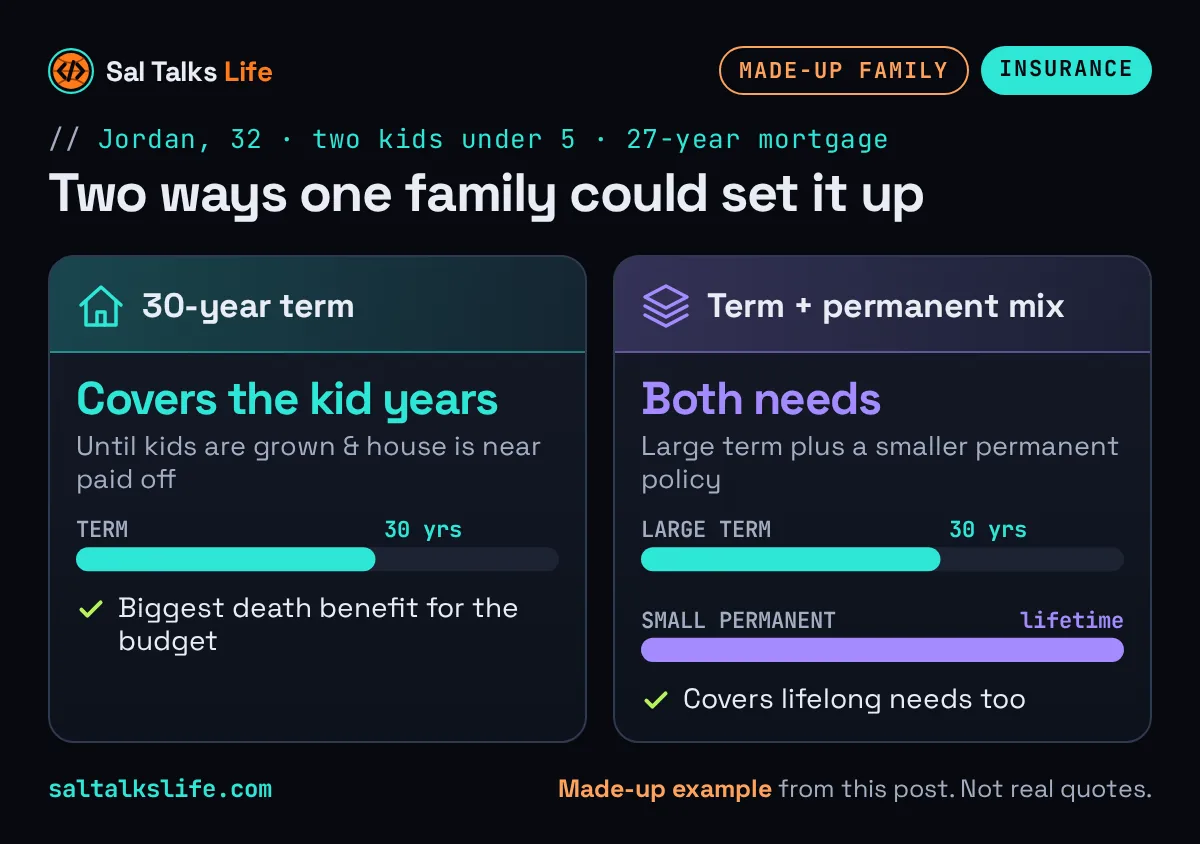
Jordan is 32, married, with two kids under 5 and a mortgage with 27 years left. Jordan’s main goal is: “If I die, my family stays in the house and the kids are taken care of.”
- A 30-year term policy covers the years until the kids are grown and the house is close to paid off. It gives the biggest death benefit for the monthly budget.
- If Jordan also wants something permanent, one option some families use is a mix: a large term policy for the “family depends on me” years, plus a smaller permanent policy for lifelong needs.
There’s no single right answer. The right mix depends on your budget, your health, and what you want the money to do.
Why I compare more than one insurance company
Here’s something many people don’t know: who you buy from affects what you’re shown. A captive agent works with one insurance company and can only offer that company’s products. An independent agent can compare policies from several companies.
I started at a captive company that could only offer its own products. I wanted to be able to offer clients more options and competitive rates, so I became an independent financial professional with a faith-based team. Now I can look at more than one company’s term and whole life options and find the one that fits your family.
Whoever you work with, it’s fair to ask, “Which companies can you quote for me?”
Common mistakes I see
- Waiting too long. Premiums are based partly on age and health, so the “I’ll do it next year” plan usually costs more.
- Only relying on work coverage. It’s a nice perk, but it’s often a small amount and may not follow you to the next job.
- Buying too little. A small policy can feel “done” but leave a big gap.
- Buying more premium than you can keep. A policy that lapses doesn’t help anyone.
- Never reviewing it. A new baby, a new house or a raise are all good reasons to take another look.
FAQ
Is term or whole life insurance better?
Neither is better for everyone. Term is usually the lowest-cost way to cover the years your family depends on your income. Whole life costs more but lasts for life and builds cash value. Many people choose based on budget and whether they have a lifelong need.
Can I switch from term to whole life later?
Often, yes. Many term policies have a conversion option that lets you move to permanent coverage without a new medical exam during a window set in the policy. Check your policy for the exact rules and deadlines.
Do term life policies have living benefits?
Many do. Accelerated death benefit riders are available on a lot of term and permanent policies, but the details vary by insurer and state. Ask exactly which illnesses qualify and how much you could access.
What happens if I outlive my term policy?
The coverage ends and no money is paid out, unless your policy has a return-of-premium feature, which usually costs more. Outliving the term is the good outcome. It means your family never needed it.
How much life insurance do I need?
Start with your debts, your family’s future costs and several years of your income, then subtract savings and existing coverage. It’s worth walking through it with someone, because every family’s numbers are different.
Let’s talk it through
If you’re still weighing term vs whole life insurance, you don’t have to figure it out alone. I offer a free, no-pressure financial review where we look at your family, your budget and your goals, and I explain your options in plain English. Book your free financial review on my Financial Services page, or read more about how I work with families.
If you like to learn on your own first, edX has free and paid courses from universities on personal finance topics, including insurance and planning for risk.
Prefer video? I talk about money and family on YouTube and TikTok. And if you’re just getting started with money, the Money Basics posts on the blog are a good next stop.
Some links in this post are affiliate links, which means I may earn a small commission at no extra cost to you. I only share resources I think can help.
Educational content only, not financial advice.
More on Life Insurance & Protection →
Want the video version? Find more on Sal Talks Life.
Comments & reactions
Comments are coming soon. Until then, ask your question under the matching video on YouTube (opens in a new tab) or TikTok (opens in a new tab), or send me a message.