The 50/30/20 Rule: A Simple Budget That Helps You Save Money
The 50/30/20 rule explained simply: split take-home pay into needs, wants and savings, see a worked example budget, and learn how to save money each month.
The 50/30/20 rule is a simple way to budget your take-home pay: about 50% for needs, 30% for wants, and 20% for savings and paying down debt. That’s it. No tracking every coffee, no 40-line spreadsheet. If you’ve been searching for how to save money without feeling like you’re on a strict diet, this rule is one of the easiest places to start.
I’m Sal. I’m a dad, a software engineer and a licensed life insurance Financial Professional, and I talk to a lot of people who feel behind with money. The good news: you don’t need a perfect budget. You need a simple one you’ll actually follow.
Where the 50/30/20 rule comes from
The rule was made popular by Elizabeth Warren and her daughter, Amelia Warren Tyagi, in their book All Your Worth: The Ultimate Lifetime Money Plan. The idea was to give regular families a balanced plan: cover the basics, enjoy your life, and build your future, all at the same time.
How the 50/30/20 rule works
Start with your after-tax income. That’s the money that actually lands in your bank account each month. If money comes out of your paycheck for things like health insurance or a retirement plan, many people add those back in so they can see the full picture, but keeping it simple with your take-home pay is fine to begin.
50% for needs
Needs are the bills you’d have to pay even in a tough month:
- Rent or mortgage
- Utilities
- Groceries (the basics, not the snacks you buy just because)
- Transportation, like a car payment, gas, insurance or a transit pass
- Health insurance and medical costs
- Childcare
- Minimum payments on debts
- Basic phone service
- Life insurance that protects your family
30% for wants
Wants make life enjoyable but aren’t required to get by:
- Eating out and takeout
- Streaming services and subscriptions
- Shopping, hobbies and entertainment
- Travel and vacations
- Upgrades, like a nicer phone plan or a bigger car than you need
20% for savings and debt payoff
This is the “future you” bucket:
- Building an emergency fund
- Retirement savings, like a 401(k) or IRA
- Extra payments on debt, beyond the minimum
- Saving for goals, like a house down payment
A worked example budget
Made-up numbers for illustration.
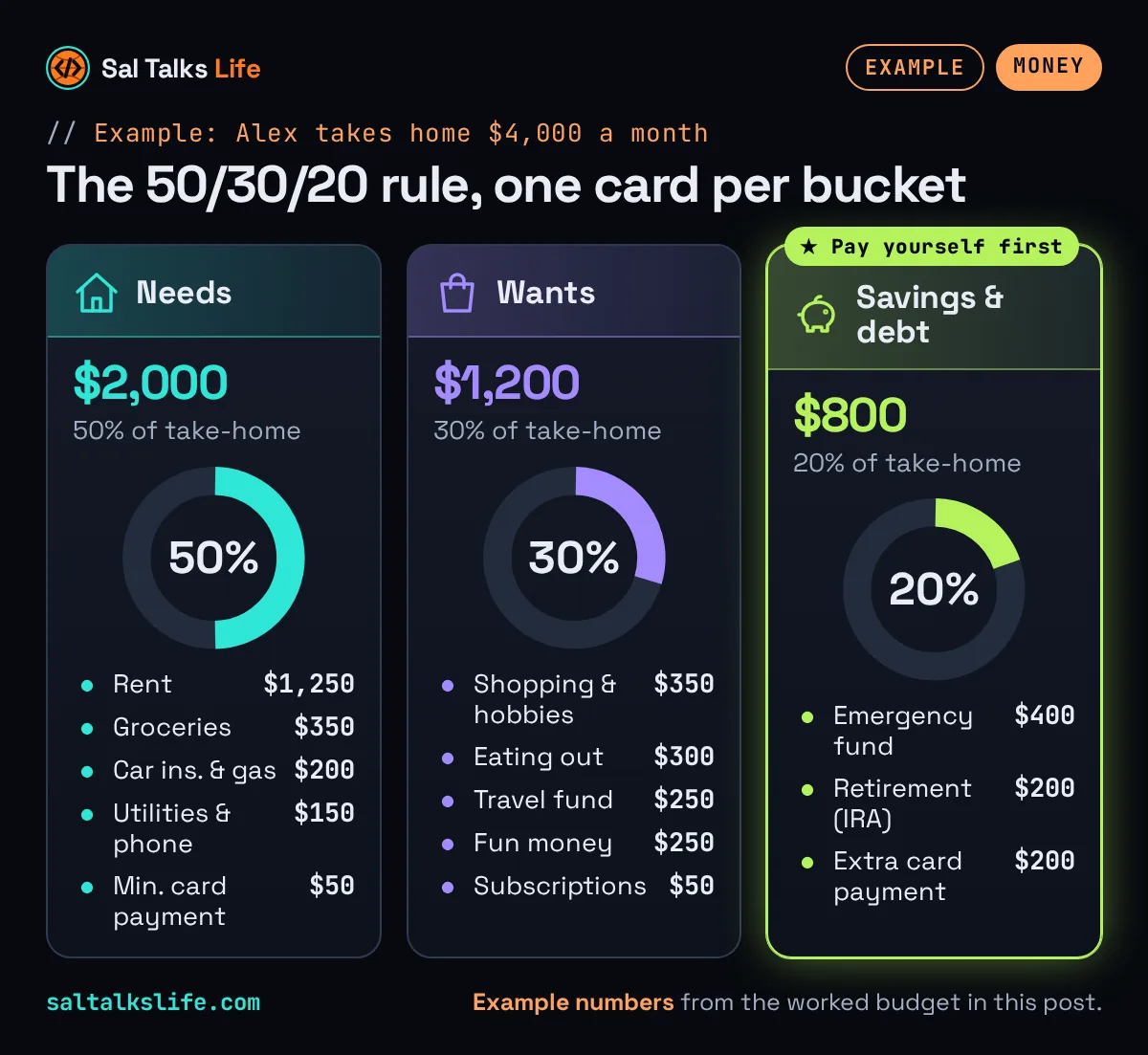
Let’s say Alex takes home $4,000 a month after taxes.
| Bucket | Percent | Monthly amount |
|---|---|---|
| Needs | 50% | $2,000 |
| Wants | 30% | $1,200 |
| Savings and debt payoff | 20% | $800 |
Here’s how Alex might fill those buckets:
| Category | Bucket | Amount |
|---|---|---|
| Rent | Needs | $1,250 |
| Groceries | Needs | $350 |
| Utilities and phone | Needs | $150 |
| Car insurance and gas | Needs | $200 |
| Minimum credit card payment | Needs | $50 |
| Needs total | $2,000 | |
| Eating out | Wants | $300 |
| Subscriptions | Wants | $50 |
| Shopping and hobbies | Wants | $350 |
| Travel fund | Wants | $250 |
| Fun money | Wants | $250 |
| Wants total | $1,200 | |
| Emergency fund | Savings | $400 |
| Retirement (IRA) | Savings | $200 |
| Extra credit card payment | Savings | $200 |
| Savings total | $800 |
That’s the whole system. Every dollar has a bucket, and Alex knows exactly how much they can spend on fun without guilt.
What if your numbers don’t fit?
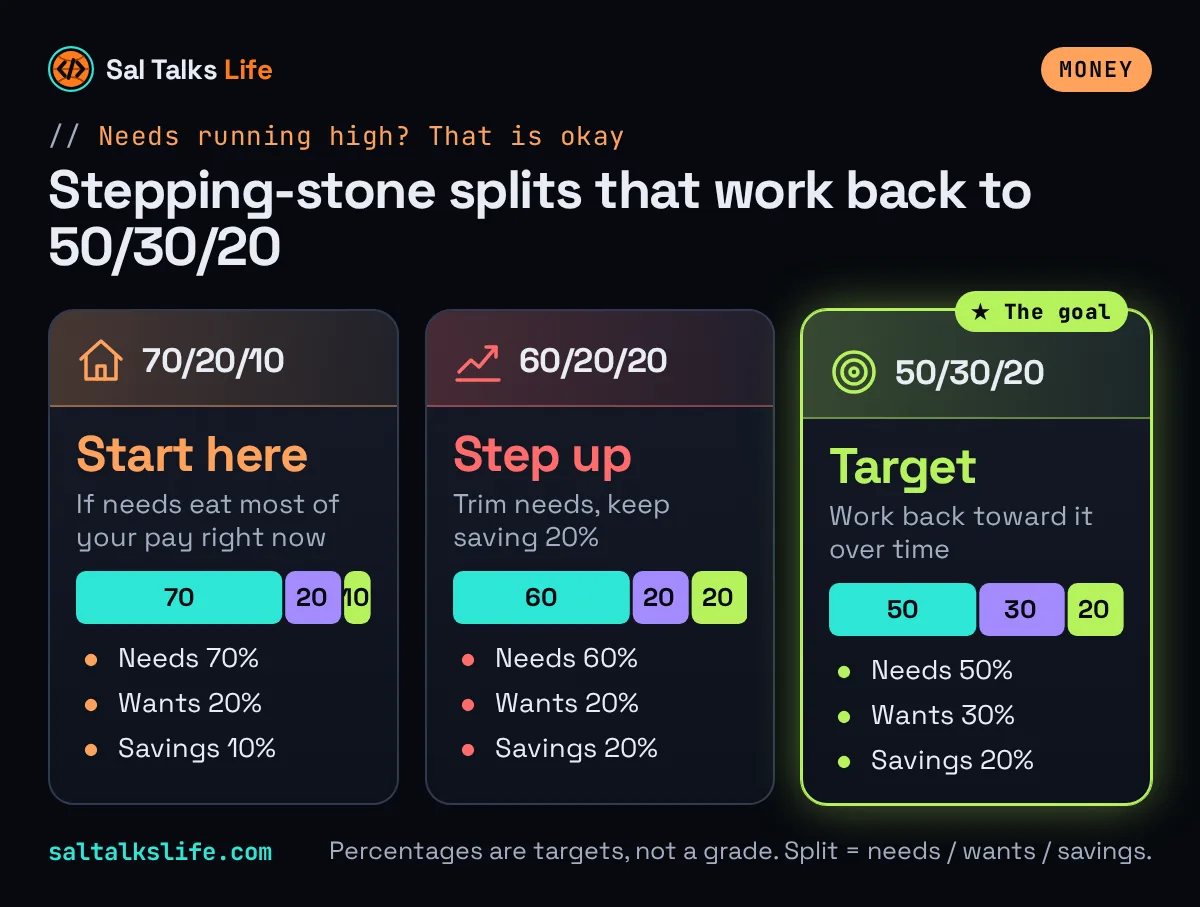
For a lot of people, especially in high-rent areas, needs come in well over 50%. That doesn’t mean you’re failing. It means the percentages are a target, not a rule you get graded on.
If needs are too high
- Try a different split for now, like 60/20/20 or 70/20/10, and work back toward 50/30/20 over time.
- Look at your biggest needs first: housing and transportation usually make the biggest difference.
- Shop around once a year for car insurance, phone plans and internet.
If you have high-interest debt
Put more of your 20% toward paying it down. Many people keep a small starter emergency fund while they attack high-interest credit card debt.
If your income changes month to month
Budget on a lower, “safe” monthly income. In good months, send the extra straight to savings or debt.
How to save money with the 50/30/20 rule: 7 steps
1. Find your real take-home pay
Look at your last two or three months of deposits. Use the average, or the lowest month if your income bounces around.
2. List your needs
Go through your bank and card statements and write down every bill that’s a true need.
3. Total your wants
This is usually the eye-opener. Add up eating out, subscriptions and shopping. Don’t judge yourself, just get the number.
4. Pay yourself first
Set up an automatic transfer to savings on payday. If the money moves before you see it, you won’t miss it as much.
5. Build an emergency fund
A common goal is 3 to 6 months of essential expenses in an easy-to-reach savings account. Start with a smaller goal, like one month, so you can win early.
6. Grab any free money
Once your emergency fund is started and your high-interest debt has a plan, look at your job’s retirement plan. If it offers an employer match, try to contribute at least enough to get the full match. That’s part of your compensation.
After that, it helps to know money gets taxed three ways: tax now (like a regular brokerage or savings account), tax later (like a traditional 401(k) or IRA) and tax-advantaged (like a Roth IRA, or for some people, properly structured cash-value life insurance such as an IUL, which has caps, floors and fees). Where the rest of your 20% goes is a great thing to sort out in a free financial review.
7. Check in once a month
Ten minutes a month is enough. Compare what you planned to what you spent, then adjust. A budgeting app like Monarch can do the sorting for you, but a notes app or a simple spreadsheet works too.
Easy ways to save money each month
- Cancel one subscription you forgot about. Most of us have at least one.
- Plan meals for the week. Fewer last-minute takeout nights adds up.
- Use a 24-hour rule. Wait a day before buying anything that isn’t a need.
- Call your providers. Ask about lower rates or promotions on internet, phone and insurance.
- Name your savings accounts. “Emergency Fund” or “Disney 2028” makes it harder to pull money out for random stuff.
- Save raises and windfalls. When your income goes up, send part of the raise to savings before your lifestyle catches up.
Don’t forget to protect the plan
A budget helps you build. But if your family depends on your income, a big part of “needs” is making sure that income is protected if something happens to you. That’s why I put life insurance in the needs bucket. If you’re not sure where to start, my post on term vs whole life insurance is a plain-English place to begin.
FAQ
Is the 50/30/20 rule based on gross or net income?
It’s based on your after-tax income, the money you actually take home. Using your gross pay would make your buckets look bigger than the money you really have to spend.
Does the 20% include retirement savings?
Yes. The savings bucket covers retirement contributions, emergency savings, other goals and extra debt payments above the minimum. Minimum debt payments usually count as needs.
What’s the best way to save money fast?
Cut your biggest expenses first, since housing, transportation and food usually have the most room. Then automate a transfer to savings on payday and pause a few wants for a set period, like 30 or 60 days.
Is the 50/30/20 rule realistic?
For some households it fits right away. For others, especially with high rent or childcare, needs take up more than 50%. Use it as a target and adjust the split until it works for your life.
How much should I have in an emergency fund?
A common guideline is 3 to 6 months of essential expenses. If that feels huge, start with a smaller first goal and build from there.
Get more simple money tips
The 50/30/20 rule works because it’s simple. Try it for one month, see what you learn, and adjust. And if you’d like to go deeper on budgeting, saving and other money basics, edX has free and paid personal finance courses from universities that you can take at your own pace.
If you want more beginner-friendly posts like this, join the free Sal Talks Life newsletter. It’s short, occasional and never spam. You can also browse the Money Basics posts or watch along on YouTube and TikTok.
Some links in this post are affiliate links, which means I may earn a small commission at no extra cost to you. I only share resources I think can help.
Educational content only, not financial advice.
Want the video version? Find more on Sal Talks Life.
Comments & reactions
Comments are coming soon. Until then, ask your question under the matching video on YouTube (opens in a new tab) or TikTok (opens in a new tab), or send me a message.