How to Become a UGC Creator (With No Experience)
How to become a UGC creator with no experience: what UGC is, the gear you need, how to build a UGC portfolio from scratch, and how to pitch your first brands.
Want to know how to become a UGC creator with no experience? Here’s the whole path in one breath: learn what brands want, make a few sample videos with products you already own, put them in a simple UGC portfolio, and pitch brands every single week until someone says yes.
You don’t need a big following. You don’t need fancy gear or a film degree either. A phone, decent light and some patience will get you started.
I’m Sal, and UGC is kind of a family thing in our house. I make UGC for brands, and so does my wife, Marianna (@motherhoodwithmarii). We each wrote a 7-day guide for beginners: I wrote the men’s edition, and she wrote the women’s. This post is the free version of that roadmap.
What is a UGC creator?
UGC stands for user-generated content. It started out meaning stuff real customers made on their own, like a review video or an unboxing. These days a UGC creator is someone brands pay to make that same kind of content: natural, relatable videos and photos that look like a real person talking about a product. Because that’s exactly what they are.
So how is that different from being an influencer?
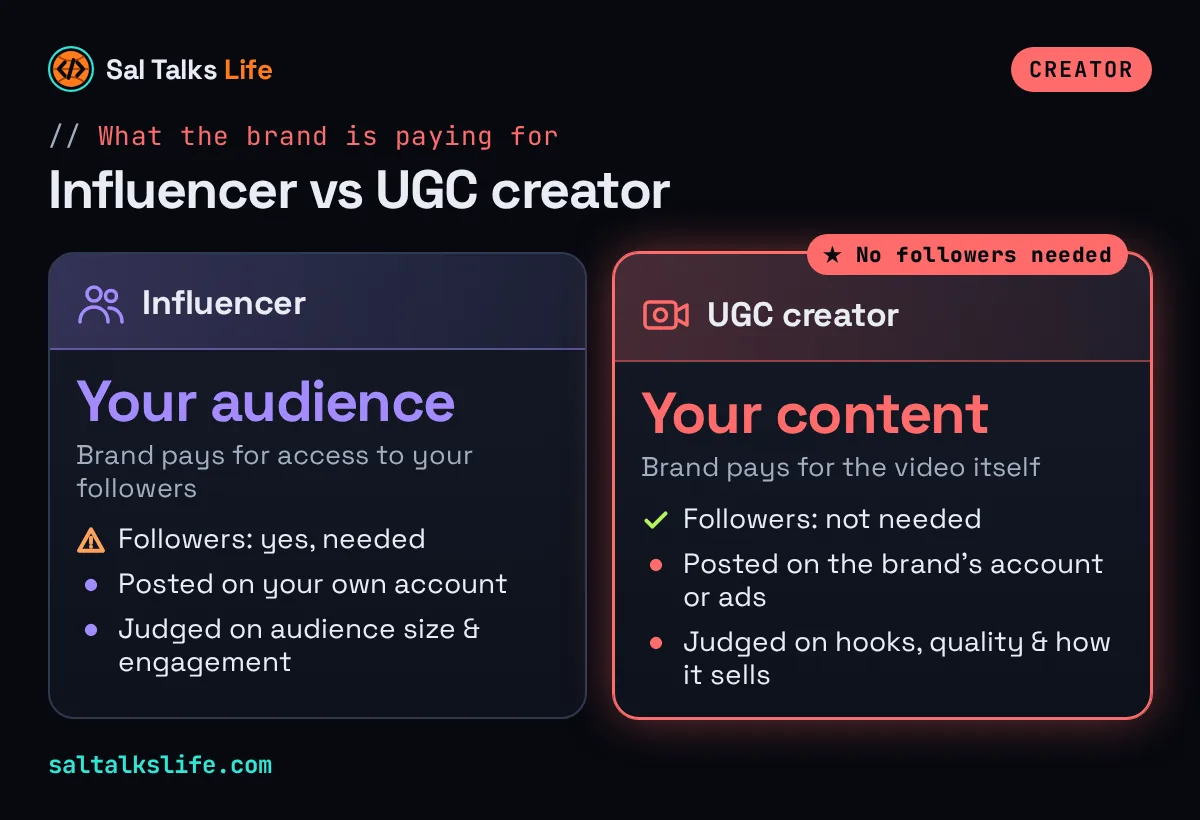
| Influencer | UGC creator | |
|---|---|---|
| What the brand pays for | Access to your audience | The content itself |
| Do you need followers? | Yes | No |
| Where it gets posted | Usually your own account | Usually the brand’s account or ads |
| What matters most | Audience size and engagement | Video quality, hooks and how well it sells |
That’s the reason UGC is so beginner-friendly. A brand can run your video as an ad on its own page, so your follower count barely matters.
What brands are looking for
Before you film a thing, get clear on what makes a UGC video useful to a brand:
- A strong hook in the first couple of seconds that stops the scroll.
- A real problem the product solves.
- Clear product shots so people can see it.
- Natural delivery. You, talking like you’d talk to a friend.
- A simple call to action, like “grab yours with the link.”
- Good lighting and clean audio. These matter more than an expensive camera.
What you need to get started
Good news: you probably own most of this already.
The basic kit
- Your phone. Shoot vertical, in the highest quality your phone allows, using the back camera when you can.
- Light. A window during the day works great. A small ring light or LED panel helps at night.
- Audio. Film in a quiet room. A small clip-on mic is a nice upgrade later.
- A free editing app. Any phone editor that lets you cut clips, add captions and add text on screen is enough.
The skills to practice
- Writing hooks
- Talking to the camera naturally
- Filming B-roll (close-ups of the product in use)
- Adding captions and quick cuts
If you want a more structured way to learn the marketing side, the Meta Social Media Marketing Professional Certificate on Coursera is one option. It covers social media content, ads and campaign results, which helps you see things from the brand’s point of view.
How to build a UGC portfolio with no clients
Here’s the catch-22 that stops most beginners: “Brands want a portfolio, but I need brands to build a portfolio.” There’s a way around it.
Step 1: Make spec videos
A spec video is a sample you make on your own, without being hired. Grab 3 to 5 products you already own and like: a skincare item, a kitchen gadget, a kids’ toy, a water bottle. Make one video for each.
Step 2: Show range
Try different styles so brands can picture you on their product:
- Unboxing: first impressions as you open it.
- Problem and solution: “I used to struggle with X, then I found this.”
- Testimonial: a simple honest review, talking to camera.
- How-to or demo: showing how you actually use it.
- Aesthetic B-roll: no talking, just clean product shots with text on screen.
Step 3: Keep it short
Most UGC ads run under a minute, and plenty are way shorter. Get to the point fast.
Step 4: Put it all in one place
Your UGC portfolio can be simple:
- A free website builder page or design-tool portfolio
- A shared cloud folder with clearly named videos
- A link-in-bio page
Include a short intro about you, who your content fits (moms, gamers, fitness, home, pets, and so on), your best 3 to 6 videos, and how to contact you. One clean link you can paste into every pitch is the goal.
Step 5: Keep it updated
Every time you finish a paid job or a better spec video, swap out your weakest piece. Your portfolio should always show your best work.
Where to find UGC jobs
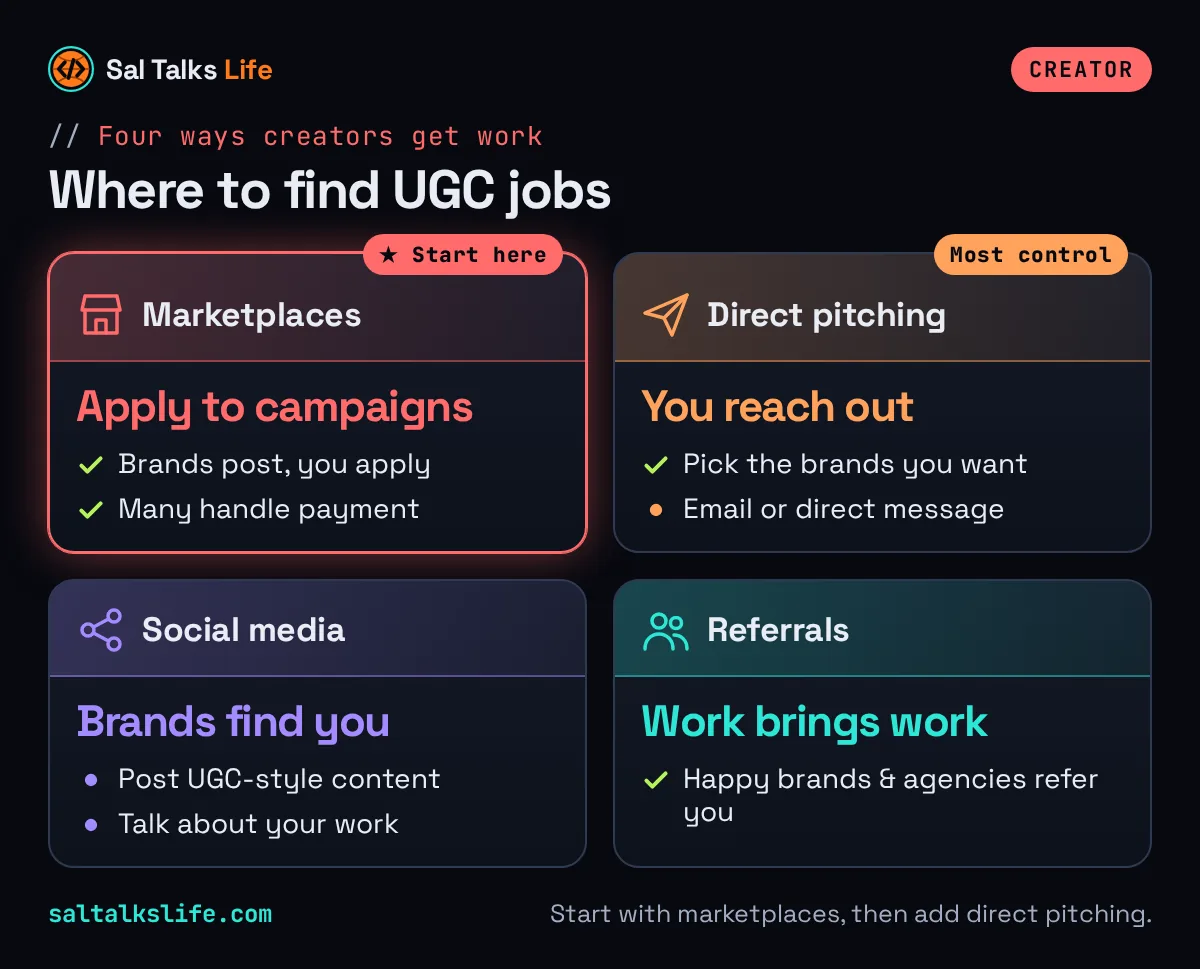
Creators usually find work in a few ways:
- Brand marketplaces and creator platforms. These sites connect brands with creators. Brands post campaigns, you apply, and many handle payment through the platform.
- Direct pitching. You reach out to brands yourself by email or direct message.
- Social media. Posting your UGC-style content and talking about your work can bring brands to you.
- Referrals. Once you work with one brand or agency, they may send you more work or refer you.
I’d start with marketplaces to get your first few jobs and reviews, then add direct pitching. Pitching directly is where you get the most say in which brands you work with.
How to pitch brands
Keep your pitches short, personal and easy to say yes to.
A simple pitch template
Hi [Name],
I’m [Your name], a UGC creator who makes [type of content] for [type of brand]. I’ve been using [their product or a similar one] and had a few video ideas, like [one specific idea].
Here’s my portfolio: [link]
Would you be open to a quick test video? Happy to share rates and options.
Thanks, [Your name]
Pitching tips
- Pick smaller brands first. Newer brands on social platforms and online stores are often more open to new creators.
- Personalize every pitch. Mention their product by name and one specific idea.
- Follow up once after about a week. Then move on.
- Track everything. A simple spreadsheet with the brand, contact, date and status keeps you organized.
- Pitch every week. Most pitches won’t get a reply. That’s normal, not personal. Volume and consistency win.
Pricing, rights and the business side
Pricing your work
Rates vary a lot by experience, niche, video length and what the brand wants to do with the content. Beginners often start lower to get reviews and samples, then raise prices as their portfolio improves. Common add-ons include extra hooks, raw footage, and faster delivery.
Usage rights
Usage rights are about how and where the brand can use your content, and for how long. Running your video as a paid ad is usually priced higher than using it only on their organic page. Spell this out in writing before you start.
Contracts and disclosure
Always get a simple agreement covering deliverables, deadlines, payment, revisions and usage. If you post sponsored content on your own account, follow the FTC’s rules and clearly disclose the partnership, for example with #ad.
Taxes
UGC money is self-employment income in the US. Set some of each payment aside for taxes and keep simple records.
A sample first week plan
| Day | Task |
|---|---|
| 1 | Study 20 UGC ads in your niche. Note hooks and formats you like. |
| 2 | Pick 3 products you own. Write a hook and short script for each. |
| 3 | Film all 3 videos. Shoot extra B-roll. |
| 4 | Edit with captions. Ask a friend which hook grabs them. |
| 5 | Build your portfolio page and add your videos. |
| 6 | Sign up for one or two brand marketplaces and fill out your profile. |
| 7 | Send your first 5 to 10 personalized pitches. |
FAQ
Do UGC creators need followers?
No. Brands pay UGC creators for the content itself, and they usually post it on their own accounts or run it as ads. Your follower count matters far less than your hooks, lighting and how clearly you show the product.
What should a UGC portfolio include?
A short intro, the niches you work in, 3 to 6 of your best videos in different styles, and your contact details. Keep it to one simple link you can drop into every pitch.
How do UGC creators get paid?
Usually per video or per package of videos, through a brand marketplace or directly from the brand. Add-ons like extra hooks, raw footage and usage rights for ads can increase what you charge.
Can I become a UGC creator with a full-time job?
Yes. Many creators start on evenings and weekends. Batch your filming on one day, edit on another, and set aside a little time each week for pitching.
How long does it take to get your first UGC deal?
It depends on your portfolio, your niche and how often you pitch. Some people land a job in a few weeks, others take a few months. Steady weekly pitching and improving your samples is what moves it forward.
Ready to start?
Want the day-by-day version? Grab The Men’s Tell All: Your First 7 Days as a UGC Creator, or Marianna’s The Tell All: The First 7 Days Becoming a Successful UGC Creator (Women’s Edition), on Payhip. You can see everything I’ve written in my Payhip store or on my Books page.
Want to see the kind of content I make for brands, or hire me for your own? Check out my UGC services page. For more, browse the UGC & Content Creation topic or follow along on TikTok and YouTube.
Keep reading
- LLC vs Sole Proprietorship: Which Is Right for Your Side Hustle?
- The 50/30/20 Rule: A Simple Budget That Helps You Save Money
Some links in this post are affiliate links, which means I may earn a small commission at no extra cost to you. I only share resources I think can help.
More on UGC & Content Creation →
Want the video version? Find more on Sal Talks Life.
Comments & reactions
Comments are coming soon. Until then, ask your question under the matching video on YouTube (opens in a new tab) or TikTok (opens in a new tab), or send me a message.