How to Build Credit From Scratch: A Simple Beginner's Guide
How to build credit from scratch: what goes into your credit score, beginner-friendly ways to start, how to check your credit for free, and habits that help.

If you’re trying to figure out how to build credit, here’s the simple version. Get at least one account that reports to the credit bureaus, use a little of it, and pay on time, every time. Keep your balances low. Don’t open a bunch of new accounts at once. Then give it time. Credit doesn’t get built overnight, but boring, steady habits really do add up.
I’m Sal. I teach money basics for beginners, and as a licensed life insurance professional I sit down with a lot of families to talk about money. Credit comes up constantly, because it touches so much: renting an apartment, buying a car, getting a mortgage, and in some states even what you pay for things like insurance.
The quick version
- Payment history matters most. Pay every bill on time.
- Keep balances low compared to your credit limits.
- Start with a beginner-friendly option, like a secured card, a credit-builder loan, or becoming an authorized user.
- Check your credit reports for free and fix any errors.
- Be patient. Time is part of the formula.
What goes into your credit score?
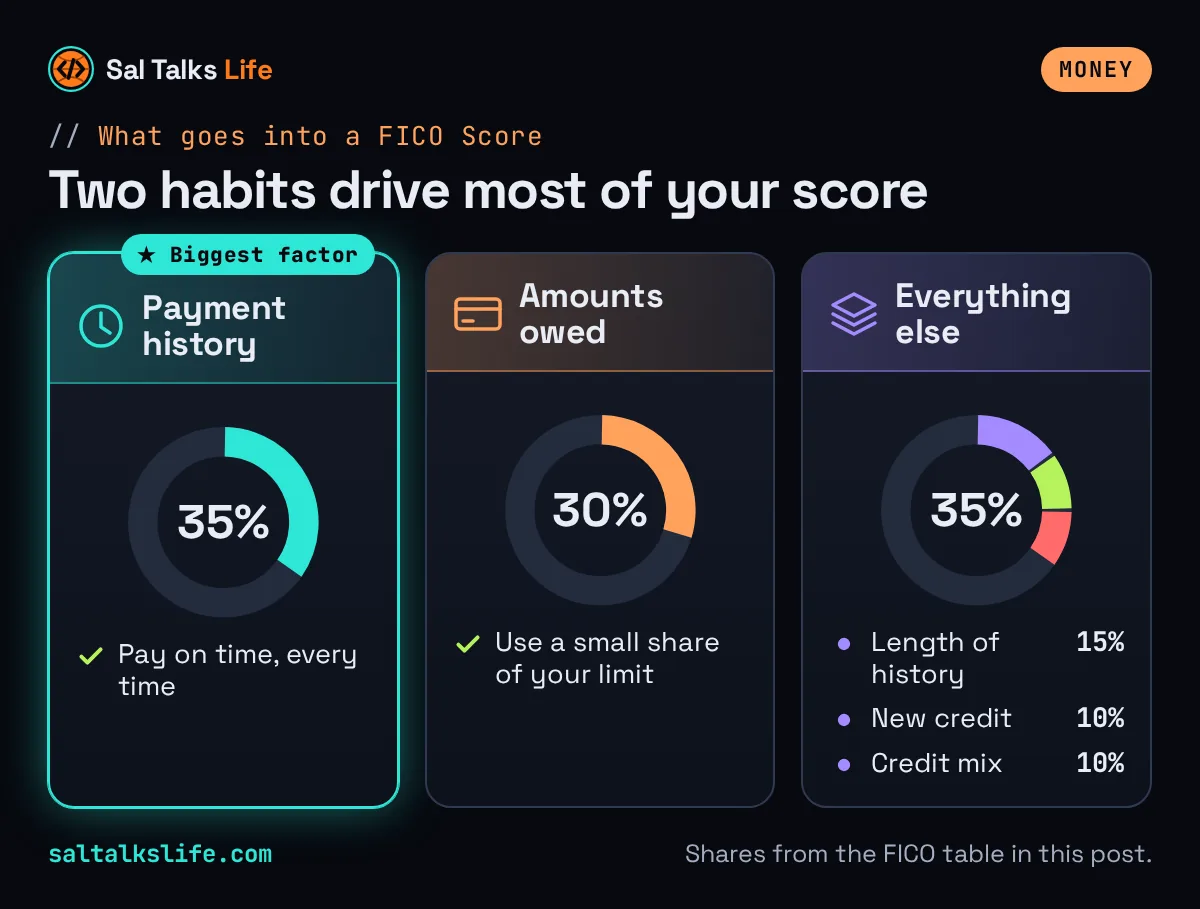
The most widely used scores are FICO Scores. According to myFICO, they’re based on five categories:
| Category | Share of your FICO Score | What it means |
|---|---|---|
| Payment history | 35% | Do you pay on time? |
| Amounts owed | 30% | How much of your available credit are you using? |
| Length of credit history | 15% | How long have your accounts been open? |
| New credit | 10% | Have you opened or applied for a lot of accounts recently? |
| Credit mix | 10% | Do you have different types of credit? |
FICO notes that these weights can vary from person to person, and your score doesn’t look at your income, age or where you live. Notice the two biggest pieces? Paying on time and keeping balances low. Both are things you control.
Step 1: Check where you stand
Before you build anything, see where you stand. You can get free credit reports from Equifax, Experian and TransUnion every week at AnnualCreditReport.com, which the FTC says is the only website authorized to fill orders for the free reports you’re entitled to by law. Checking your own report doesn’t hurt your score.
Look for:
- Accounts you don’t recognize
- Late payments that weren’t late
- Wrong personal information
If you find a mistake, you can dispute it with the credit bureau. The CFPB’s credit reports and scores page explains how.
No credit history at all? Your report might be empty. That’s okay. Everybody starts at zero.
Step 2: Pick a beginner-friendly way to start
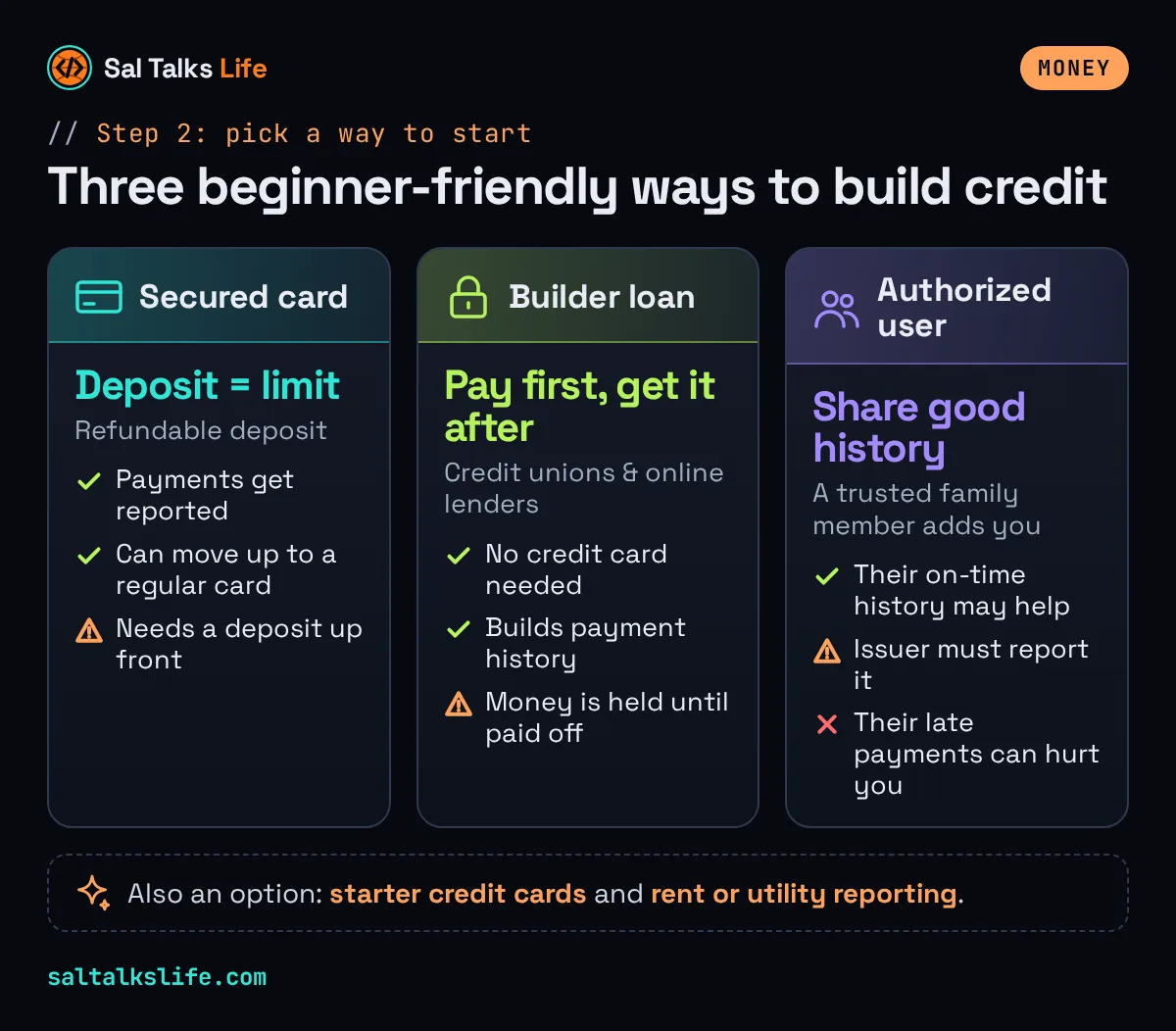
Secured credit card
You put down a refundable deposit, and that deposit usually becomes your credit limit. You use the card like any credit card, and your payments get reported. Many secured cards let you move up to a regular card after a period of on-time payments.
Starter credit cards
Some cards are designed for people with limited credit history and don’t require a deposit. Card issuers such as Mission Lane offer cards aimed at people working on their credit. Whatever card you look at, compare the annual fee, interest rate and other fees carefully before you apply.
Credit-builder loan
Credit unions and some online lenders offer these. The money you “borrow” sits in an account while you make payments. Once it’s paid off, the money’s yours, and you’ve built a payment history along the way. It’s kind of a forced savings plan that also builds credit.
Becoming an authorized user
A family member with good credit adds you to their card. Their on-time history on that account may help your credit, as long as the issuer reports authorized users. Just make sure it’s someone you trust. If they pay late, that can follow you too.
Reporting rent or utility payments
Some services can report rent or certain bill payments to the credit bureaus. Not every scoring model counts them, but they can help some people get started.
Step 3: Use credit the smart way
- Use a small amount. Put one regular bill, like a streaming subscription, on the card.
- Pay on time, every time. Set up autopay for at least the minimum so you never miss a due date.
- Pay in full when you can. That way you avoid interest.
- Keep your balance low compared to your limit. Using less of your available credit is generally better for your score.
Step 4: Build the habits that grow your credit
- Keep old accounts open when it makes sense, since the length of your history matters.
- Space out new applications. Each application can add a hard inquiry, and FICO considers inquiries from the last 12 months.
- Ask for a credit limit increase once you’ve built a history, if you trust yourself not to spend more.
- Check your reports regularly, especially before big purchases like a car or home.
How long does it take to build credit?
It’s different for everyone. Generally you need some history on your report before a score can even be generated, and it keeps improving as you stack up months and years of on-time payments. The trick is to start, stay consistent, and not get discouraged when it feels slow.
Common credit mistakes to avoid
- Missing payments. Even one late payment can hurt.
- Maxing out cards. High balances weigh on your score.
- Opening lots of accounts at once. Too many new accounts and inquiries can lower your score.
- Co-signing without understanding the risk. You’re on the hook if they don’t pay.
- Paying for “credit repair” promises. You can dispute errors yourself for free. Be careful of anyone promising to erase accurate information.
Credit and the bigger picture
Good credit is a tool. It can save you money on interest and open doors for your family. But a credit card isn’t a safety net, and my family knows that firsthand. When my brother died young and unexpectedly, my mom struggled to pay for his funeral and gravestone, and she had to start a GoFundMe. No credit score fixes a moment like that. What helps is a simple budget, some savings, and the right protection in place before you need it. If you’re getting your budget in order, my 50/30/20 rule post is a good place to start.
I’ve also seen people carry a lot of shame about their credit. Please don’t. Wherever you are today, you can take a step forward. I believe in second chances, and a credit score is just a snapshot of where you are right now. It’s not who you are.
FAQ
What is the fastest way to build credit?
There’s no instant fix, but the habits that help most are paying every bill on time and keeping your balances low. Becoming an authorized user on a trusted family member’s well-managed card can also help some people build history faster.
Can I build credit without a credit card?
Yes. Credit-builder loans, some installment loans, and services that report rent or bill payments can all help. A credit card is just one option.
Does checking my credit score lower it?
No. Checking your own credit report or score is a soft inquiry and doesn’t affect your score. Hard inquiries happen when you apply for new credit.
How do I build credit at 18?
Many young adults start with a secured card, a student or starter card, or by becoming an authorized user on a parent’s account. Use a small amount, pay on time, and keep your balance low.
What credit score is considered good?
FICO Scores generally range from 300 to 850, and higher is better. What counts as “good” can depend on the lender and the type of credit you’re applying for.
Keep building
Building credit is a lot like building anything worth having: small, faithful steps, over and over. Open one account, set up autopay, and check in on your progress every few months.
If you want to learn more about money at your own pace, Coursera has free and paid personal finance courses from universities and companies. And if you’re thinking about protecting your family while you build, I’d love to help. Book your free financial review and we’ll look at the whole picture together.
Want more simple money tips like this? Join the free Sal Talks Life newsletter, browse the Money Basics topic, or watch along on YouTube and TikTok.
Keep reading
- The 50/30/20 Rule: A Simple Budget That Helps You Save Money
- How Much Life Insurance Do I Need? A Simple Way to Figure It Out
- How to Invest in the S&P 500: A Beginner’s Step-by-Step Guide
Some links in this post are affiliate links, which means I may earn a small commission at no extra cost to you. I only share resources I think can help.
Educational content only, not financial advice.
Want the video version? Find more on Sal Talks Life.
Comments & reactions
Comments are coming soon. Until then, ask your question under the matching video on YouTube (opens in a new tab) or TikTok (opens in a new tab), or send me a message.